November 27, 2026

Brian Overby
You buy a call the day before a company reports earnings. The news comes out and the stock goes up. But the next morning, your call is worth less than you paid for it. You picked the right direction and still lost money, and the reason is IV crush.
IV stands for implied volatility, which is the market's guess about how much a stock will move. Before earnings, that guess is high. Once the news is out, it often drops fast, and that sharp drop is IV crush. When implied volatility falls, calls and puts both lose value, so the stock has to move far enough to make up for it.
In this post I'll show you why implied volatility climbs before earnings and what happens to an option's price the morning after. I'll also cover what IV crush means for buyers and for sellers. One worked example carries all the numbers, so you can follow the math from start to finish.
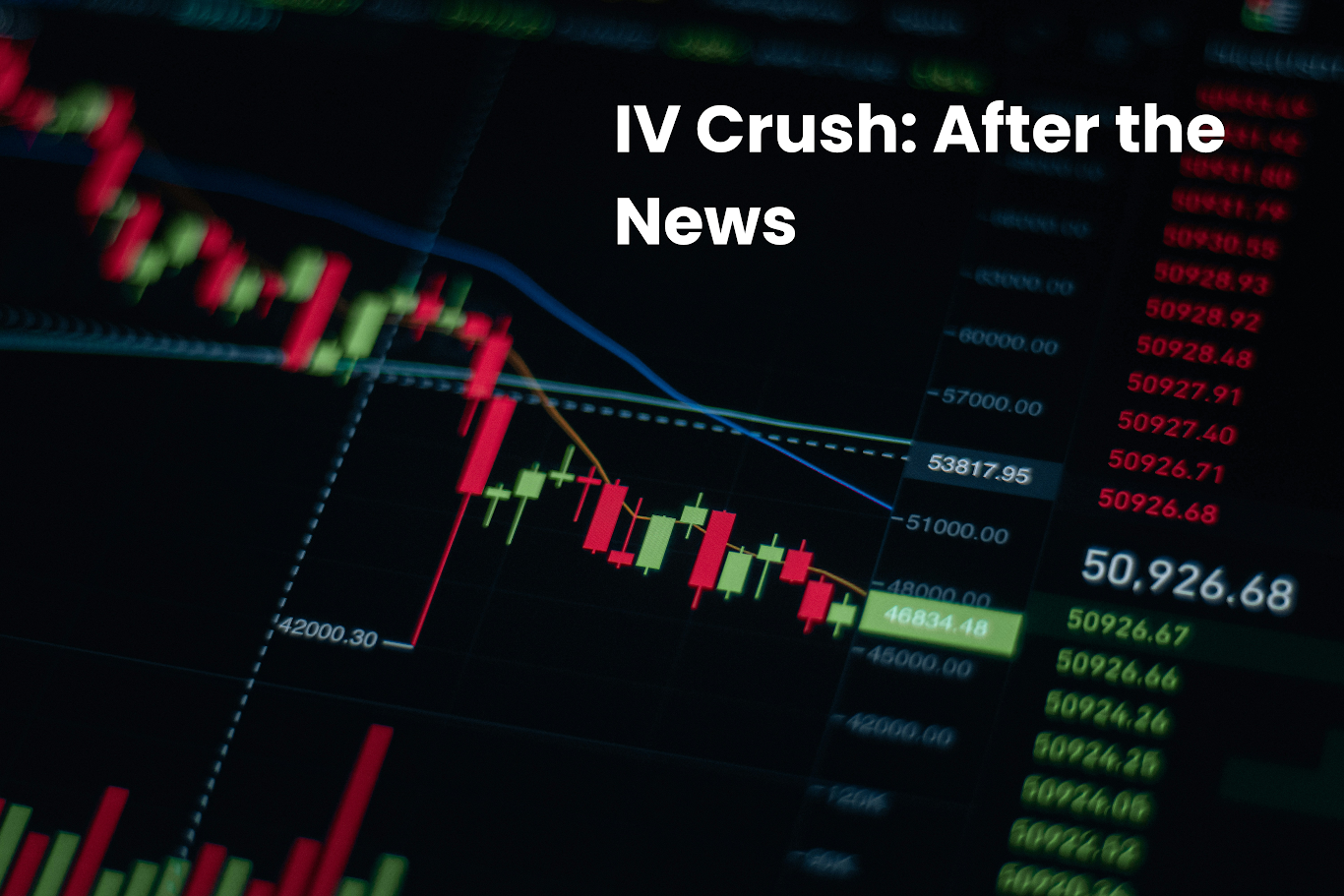
IV crush is a fast drop in implied volatility after a known event has passed. Option prices fall with it. You see it most often the morning after an earnings report.
An option's price has two parts. Intrinsic value is the amount an option is in-the-money. Time value is the rest of the price, which is the extra a buyer pays for the chance that the stock moves in the option's favor before expiration. Implied volatility affects only the time value. When the market expects a bigger move, time value goes up, and intrinsic value stays the same.
Once the event is over, the news is out and most of the uncertainty is gone. Traders stop paying extra for the unknown. Implied volatility falls back toward a more normal level, and time value shrinks with it. In the example I use later in this post, implied volatility drops from 80% to 30% overnight.
Calls and puts both carry time value, so the drop takes value from both at the same time. It does the most harm to options whose price is almost all time value, such as at-the-money options.
A company announces its earnings date ahead of time, so everyone knows when the news is coming. Nobody knows what the report will say. A surprise, good or bad, can move the stock a lot in one morning.
That changes how people trade the options. Buyers want to own calls or puts before the report. Sellers ask for a higher price, because they're taking on more risk. So option prices go up, even if the stock has barely moved. Implied volatility is worked out from option prices, so it goes up too. That run-up is what IV crush takes away later.
The rise is strongest in options that expire soon after the report. They have little time left, so the report is the main thing that can still move their price. Earnings come around four times a year, which makes them the most common cause. These are the events that most often push implied volatility up:
In each case, the higher option prices show how big a move the market expects, and I'll put numbers on that in the example below.
Here's an example with XYZ, an imaginary stock that trades at $50. The company reports earnings tomorrow. I'll use one option to show what happens: the 50-strike call that expires in 8 days.
Implied volatility on XYZ options is 80%. The 50-strike call costs $2.36 per share. One contract covers 100 shares, so the call costs $236. All of that is time value. A 50-strike call on a $50 stock isn't in-the-money, so it has no intrinsic value.
The 50-strike put costs the same $236. Buying both would cost $472, or $4.72 per share. That price is a rough measure of the move the market expects, which is about $4.72 up or down.
The report is out. Implied volatility has dropped from 80% to 30%, and the call has 7 days left. What the call is worth now depends on where XYZ trades.
If XYZ rises to $52, the call is worth $220. You were right about the direction, and you're still down $16 ($236 minus $220). If XYZ stays at $50, the call is worth $83, a loss of $153. If XYZ jumps to $54, the call is worth $403, a gain of $167. To get back to its $236 cost, the call needs XYZ at about $52.20.
Look at the $52 case again. The call has $200 of intrinsic value and only $20 of time value left. If implied volatility had stayed at 80%, the same call would be worth about $339, a gain of $103. The drop in implied volatility took about $119 away, and it turned a winning trade into a small loss. The measure for this effect is called vega. Vega belongs to a group of measures known as the option Greeks. Each Greek tracks one thing that changes an option's price. Vega tracks implied volatility, and it tells you how much the price changes for each one-point change.
IV crush works against the person who owns the option and for the person who sold it. The buyer paid for the high implied volatility, and the seller collected it.
If you buy a call or a put before earnings, being right about the direction isn't enough. The stock also has to move far enough to cover the time value you lose. In my example, the call buyer needed XYZ at about $52.20. A trader who bought both the call and the put paid $472. That trade is called a straddle, and it would need XYZ to move about $4.70 up or down.
You can't escape the drop if you hold an option through the report. You can check a few things before you pay, though:
The seller is on the other side of the trade. A trader who sells the same 50-strike call, without owning XYZ stock, collects $236. If XYZ stays at $50, the seller can buy the call back for $83 the next morning and keep $153. That's how traders try to profit from the drop in implied volatility.
The risk is the move itself. If XYZ jumps to $55, the call is worth $501, and the seller is down $265. The loss keeps growing the higher the stock goes. The high price a seller collects before earnings is the market's payment for taking that risk.
Yes, but less. Only time value falls, and most of an in-the-money option's price is intrinsic value. Compare two calls with XYZ still at $50 after the report. The 45-strike call is $5 in-the-money. It goes from $557 to $500, a drop of about 10%. The 50-strike call goes from $236 to $83, a drop of about 65%.
No. It follows events with a known date, because option prices rise before them. News that comes with no warning has no rise before it, so there's nothing to take away. Implied volatility can also stay high after earnings if the report raises new questions about the company.
You can estimate it with vega. Most option chains show vega next to each option's price. Multiply the vega by the number of points you expect implied volatility to fall. The 50-strike call has a vega of about .03. That means its price changes by $.03 per share for each point. A drop of 50 points (from 80% to 30%) works out to about $1.50 per share, or $150 per contract. That's close to the $153 the call lost in my example. Treat the result as an estimate, because vega changes as implied volatility falls and time passes.
An earnings trade can lose money even when you're right about the stock. That happens because the option's price already includes a big move. Before you buy or sell an option ahead of a report, these are the five things I'd check:
These checks won't remove the risk, but they show you what you're paying for before the report. When you know how far the stock has to move, you can decide whether the trade still makes sense with IV crush taken into account.